Environmental and Safety Management Manual Thermal Management, Environmentally Controlled Cabinet Outdoor Cabinet for Communications Microwave Radio Equipment and Traffic control products, Weatherproof Aluminum Cabinet Enclosures, Outdoor cabinets, Weatherproof Nema Rated Outdoor Cabinet Enclosure, Traffic Control, Video Detection, Controller Cabinets, Traffic Equipment, Traffic Signals, Light Emitting Diodes, Strobe Lighting, Loop Monitors, Wireless communications, Pedestrian Signal, NEMA Traffic Controllers, Monivision, Inductive Loop Detector, Loadswitch, Solid State Flasher, Flow Monitoring, Data Acquisition, Incident Monitoring, traffic Supply, Wireless.
Clean, Renewable Energy – A Clear Investment for the Future


Help

Search and Order Online our products database
Click Here! To Search for prices and Order Online our products database

Add Your Email
To Receive News

Contact Us

ABC Catalog
Airfield
Automation
Communications
Components
Computers
Electronics
IQ Fuel Cell
Government
Hospital
Lighting
Power
Products
Security
Solar Energy
Solar LED Lighting
Solar Systems
Traffic
UPS | Generators
Visual Signals
Water Pumps
Wind Generators
Protecting Critical Government Infrastructure Click Here!  e-Procurement solutions for Government integrated supply chain management services for the e-procurement requirements of Business to Government (B2G) markets.

Become  eDealer
Customers
Export
ˇHablamos Espańol!


Credit Card Transactions Secured by VeriSing!

We use the industry-standard Secure Sockets
Layer (SSL) technology to prevent information from being intercepted.

Thank you for your Business
.
Order Status you can track the status of your order
 
Electrical Enclosure Cooling With Special Purpose Air Conditioners
 
Environmentally Controlled enclosures and Cabinet weatherproof Aluminum Cabinet Enclosures,
 Environmentally Controlled Cabinet Outdoor Cabinet for Communications Microwave Radio Equipment and Traffic control products


Enclosures:

Enclosures Quality, Environmental and Safety Management Manual Thermal Management.


Heat producing power and control components are being packaged in less space, increasing the power densities in electronic and industrial equipment enclosures. Computers, programmable logic controllers, microprocessors, variable speed drives, power conversion and storage devices have found their way into every industrial and commercial environment.

The problem of dissipating the heat generated to prevent premature failure or process shutdown can be solved by several means. The surface area of the enclosure itself may serve as a passive means to dissipate this heat, providing the ambient conditions are below the desired enclosure interior temperature and the internal heat load does not cause an unacceptable rise in temperature. When this is not possible, an active approach is necessary.

Open loop powered ventilation, or closed loop cooling may be used.
Open loop ventilation uses ambient air to remove the heat, and may consist of small muffin type fans that exhaust or supply an electrical enclosure, at times with filters to prevent airborne aerosols and dust from entering the enclosure. The fans have the advantage of utilizing a minimum of enclosure space and will move a substantial volume of air where flow is virtually unimpeded. Cost and complexity is minimized. Where density of components impedes airflow, packaged blowers or motorized impellers may be arranged to operate against these higher static pressures. With a rack enclosure, supplemental fan trays may be used to spot cool or supplement other air-moving devices.

Where maximum internal enclosure design temperatures cannot be maintained using open loop ambient air cooling, closed loop devices need to be considered. Air to air heat exchangers, water to air heat exchangers, thermoelectric heat exchangers and air conditioning units are able to cool a confined amount of air within an enclosure. Heat is transferred to the respective devices' ambient side where an air mover or water coil transfers the heat to the room or outdoors.

Air conditioners and water to-air heat exchangers provide the greatest capacity to transfer heat in closed loop conditions. They have the unique ability to maintain a lower than ambient temperature and reduce the humidity within the controlled space. It is important to note that enclosure design temperatures may exceed the ambient temperatures, yet be below the electronic components' design limits. Depending upon the NEMA enclosure type, which designates the environmental hazard from which the contents are being protected, an air conditioner can be provided to operate in most locations. Locations subject to dust, dripping liquids, rain, wash down and corrosive atmospheres can utilize these "Special Purpose Air Conditioners".

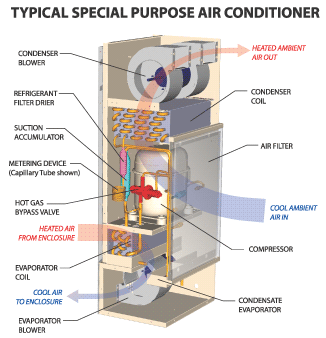
A typical "Special Purpose Air Conditioner" operates as follows. Heat is transferred from the enclosure components by circulating air around and through them, the air is then cooled, dehumidified and returned to the enclosure without the admission of air from the outdoors. The heat is removed from this air within the air conditioner and discharged by means of a vapor compression refrigeration cycle. This takes place in a hermetically sealed system, utilizing either an air-cooled or water- cooled condenser coil. A schematic of a typical Air Conditioner is illustrated (see figure 1).

The compressor forces refrigerant, in vapor form, into the condenser coil where it is cooled by ambient air. As it cools, the refrigerant condenses into a liquid, which is passed through a filter to remove impurities and excess moisture. The liquid refrigerant flow is metered by a thermostatic expansion valve or capillary tube, to control its admission to the evaporator coil which is a part of the closed loop on the inside of the enclosure.

The refrigerant enters the evaporator as a liquid beginning to vaporize. As the blower or fan driven heated air from the enclosure passes through the evaporator coil, the heat is transferred to the refrigerant, converting the refrigerant to vapor. High levels of humidity present in the air are removed by condensation, the water is drained to the outside and evaporated in some cases. This cool, dehumidified air is then returned to the enclosure. After the heat is transferred to the refrigerant in the evaporator, the refrigerant passes into an accumulator, where any remaining liquid is separated. The gas then returns to the compressor to repeat the cycle in a continuous process.

Control of the system is generally kept simple. When power is applied to the air conditioner the evaporator blower starts and runs continuously. If the temperature within the enclosure is high, the condenser blower and the compressor turn on, operating until the thermostat setting is reached. The thermostat is used as a low limit setting. This is typically 75°F, the point at which the compressor and the condenser fan or blowers are turned off. Air within the enclosure continues to be circulated by the evaporator blower or fan, picking up heat from the components within the enclosure. The thermostat has a differential setting that is typically 12-15 degrees above the low limit setting. When the air circulated within the enclosure rises by this amount, or at about 90°F, the compressor and condenser blower turn back on reducing the enclosure internal air temperature once again. Therefore, at start up of an enclosure system, it would be normal for the internal temperature to rise to this temperature before the refrigerated cooling would begin. As the air cools, a balance of temperature within the enclosure is reached, ideally the compressor and condenser fan continue to run most of the time until the heat load changes.
 

It is important to understand that enclosure cooling is not "comfort "cooling as found in homes and buildings. Heat producing power and control components are typically limited to maximum enclosure air temperatures of 100°F to 110°F. The actual component surface temperatures are higher. Maintaining enclosure temperatures too low often becomes problematic. Condensation may form on live electrical surfaces if their temperature falls below the dew point of the air. Subsequent corrosion or electrical safety becomes a serious issue.

Various control features are available to operate in cooler ambient conditions found outdoors or in poorly heated settings. Compressor short cycling controls may be added to prevent damage caused by frequent starting when heat loads fluctuate.

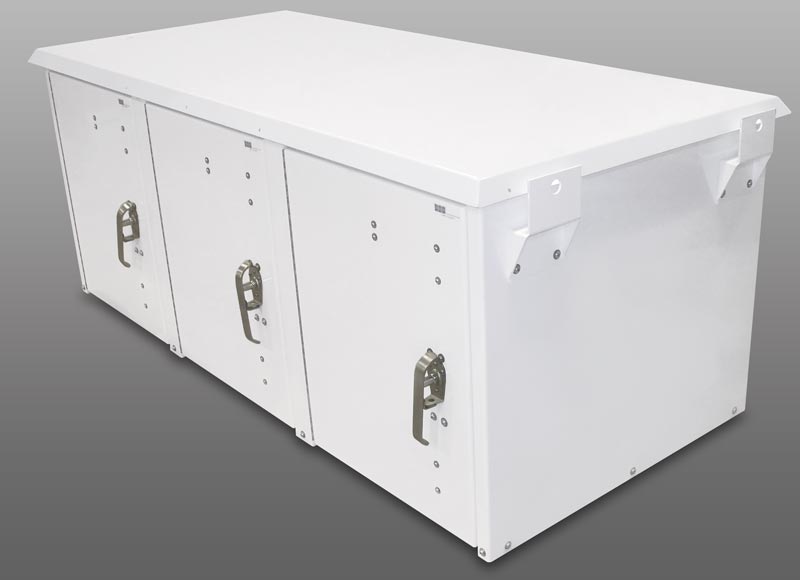
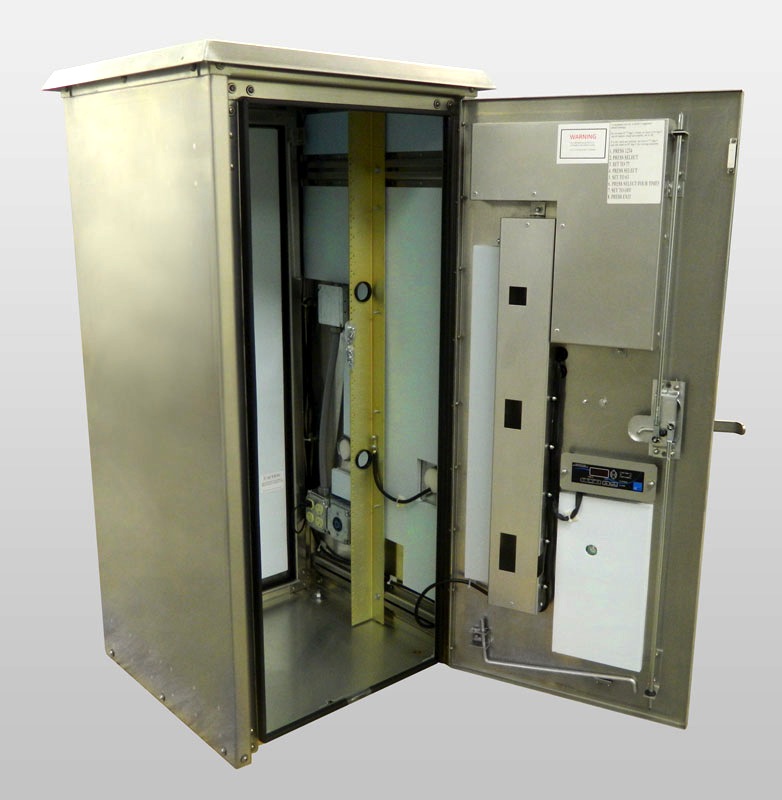
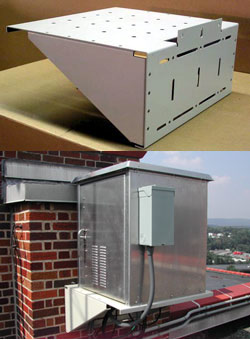
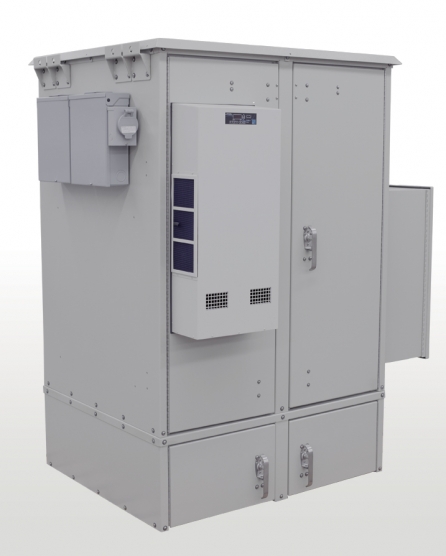
The air conditioner typically carries an agency marking such as UL, Underwriters Laboratories which designates the environmental hazard from which the contents are being protected. This marking should be matched to the enclosure to be cooled. Typical examples include NEMA 12, (indoor use, protection from dust and dripping liquids) (see Figure 2), NEMA 3R, (outdoor use and rain proof) (see figure 3) and NEMA 4/X (outdoor or indoor use, protection from wash-down and corrosive environments) (see figure 4).

Sizing calculations for the selection of an air conditioner are accomplished with ease via software available on manufacturers' websites or on available software copies. The internal heat load is determined based upon measurement or estimation. Enclosure surface area, desired maximum internal enclosure temperature, degree of thermal insulation if any, ambient temperature and for outdoor use, solar load are used to determine the total heat load in BTUH. It is important to note that the solar load and the degree of insulation can become very significant. Entering a closed automobile after it has sat in the hot summer sun illustrates this point.

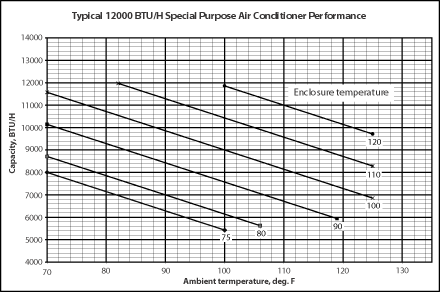
For best results be careful not to oversize the unit. Be certain that both the evaporator and condenser air flow paths cannot short circuit, or are impeded. Be cautious of adding protective covers to the outside of the unit which may reduce air flow and unit thermal performance. Seal the electrical enclosure to prevent humidity and outside air from entering. Closed loop enclosure cooling is the goal. Consult performance data, or contact the manufacturer for temperature conditions other than the rating points shown in most catalogs. Typical performance is shown in figure 5. A properly sized, well designed system, free of refrigerant leaks, with a stable power supply will cool critical systems trouble free for many years.

Should you have any technical questions please contact us
 
CABINET COOLING TIPS/MEETING DESIGN CHALLENGES

THINK ABOUT COOLING...EARLY!
Cooling needs should be evaluated early in the design process. Nearly all systems require some degree of forced cooling. Early estimates of the location of components in the cabinet, the heat to be dissipated, and the amount of space needed for the cooling device will save time, trouble and expense. 

AMBIENT AIR VS. CLOSED-LOOP COOLING
Keep it simple. If ambient air is cool and clean enough, use it. It's free. If the ambient is too hot, dirty or corrosive, a closed-loop system is needed. A Heat Exchanger is usually a lower-cost choice than an Air Conditioner. See if it will do the job. Don't over-cool. Don't oversize the cooling equipment.

FAN OR BLOWER?
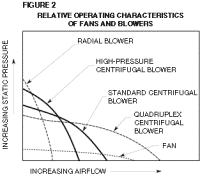
Propeller fans are designed to move large volumes of air at low static pressure. Blowers are used in higher static pressure applications, and are at maximum efficiency when operating near their peak static pressure. Figure 2 shows their relative operating characteristics.

PRESSURIZE, DON'T VACUUMIZE!
Pressurization of the cabinet is far more desirable than drawing the air out. Plan to pump filtered air INTO the cabinet, to gain the advantage of using cracks between panels, around doors or other small openings as part of the exhaust area rather than as sources for the intake of dust and dirt. If pressurization is impossible and a fan or blower must be used to exhaust the enclosure, a filter at the air inlet is recommended.

KEEP IT CLEAN
Nothing is more important than CLEAN filters. Clogged filters restrict airflow and cause motors, compressors, etc. to work harder and fail prematurely. Timely filter servicing is vital to your system.

KEEP INLET AND EXHAUST AIR FAR APART
Be sure that all of the exhaust area is located downstream, as far as possible from the air inlet and beyond all heat-producing components. An open-base cabinet sitting only one-quarter inch off the floor can waste a substantial percentage of cooling air even if the air is directed upward initially. A properly planned air path will avoid all "short circuits" or losses by forcing the cool supply air to pass through the components that are to be cooled before reaching the exhaust area. This will allow for a maximum of cooling efficiency. 

LET NATURE HELP
Cooling air should enter the enclosure from as low as possible and leave the enclosure from above the highest hot component. Thus, the forced air flows upward through the heat-producing components and adds to the natural buoyancy of the heated air.

A "BOOSTER" CAN SAVE SPACE AND COST
A booster fan located downstream or at the outlet can draw added cooling power through densely packed components. It could permit the use of a smaller, quieter packaged blower than originally indicated, allowing more panel space for other uses.

ENTERING AIR NEEDS EXIT ROOM
The cross-section area of the airstream throughout the flow path in the cabinet should be at least equal to the effective area of the air intake. If this ratio is less, "choking" of the delivered air may result. On the basis of the average grille material, with 65% open or effective area, the following table gives the typical effective area which should be allowed for discharge.

19" Front Panel    Circular Fan
Intake                Intake 
 3.50"   28 sq. in.   6.50"  33 sq. in.
 5.25"   47 sq. in.   8.00"  50 sq. in.
 7.00"   68 sq. in.   9.00"  64 sq. in.
 8.75"   85 sq. in.   9.50"  71 sq. in.
10.50"  100 sq. in.  10.00"  78 sq. in.
For intake and exhaust grille and filter grille assemblies, use the Accessories and Options section.

USE DUCTS FOR EVEN COOLING
If the maintenance of an even temperature from top to bottom of the enclosure is important, ducts along the sides of the enclosure offer an ideal solution. Multiple duct outlets allow precise control of the location and quantity of air delivered. 

COMPONENT LOCATION
Where possible, locate heat sensitive electrical components toward the bottom of the enclosure, since the warmest air temperatures will be at the top. Maintain adequate spacing between components within the enclosure to minimize airflow restriction.

BAFFLES SOMETIMES WORK WONDERS
At times, an excessively hot component or an isolated area in the enclosure presents a problem in an otherwise well-cooled system. A baffle to channel air across the location is often the best solution.

VIBRATION ISOLATION
Neoprene vibration isolators minimize the possibility of trouble associated with vibration. All portions of a system will respond to periodic forces in varying degrees. This excitation can occur regardless of the balance or design of the air-moving equipment, since any given construction could be in harmony with any of the driving forces in the blower motor. If the sympathetic vibration level is unacceptable, slight weight change or redistribution will usually alleviate the problem.

Outdoor, Pole, Wall, Pad, and Traffic NEMA Enclosures
Racking and Non Racking Metal Cabinet Enclosures

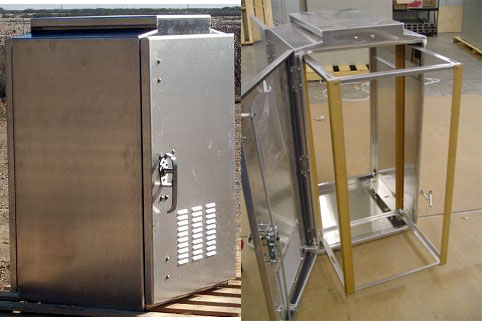
The enclosures are normally used to house electrical controls, terminals and instrumentation. Typical industrial applications include traffic control, electronics and telecommunication. The cabinets are available in many sizes and configurations, including double door and four door versions


Pre-Configured Outdoor Cabinet Solutions
Configured Outdoor Cabinet Solutions are designed to meet the most popular cabinet needs. All cabinets are made from Alum flex material, a unique material, designed to give the best durability at the lightest weight


Outdoor Series Cabinets
The 777 series cabinet is a new design in communication cabinet enclosures, being as rigid as steel and yet feather light. This series cabinet offers all the protection needed for tOkay's outdoor requirements. Features front and rear doors, adjustable rails and a sunshield that sits 1/2" off the enclosure. Ultimate security is provided by a three point locking system. Class 250, NEMA 4 rated. The OKOk series cabinets offers a powder baked cream color option.


Pole or Wall Mounted Cabinets
Used in wall or pole mounted applications, the OKPOk series is a totally weatherproof Class 250, NEMA 4X rated enclosure. Each cabinet is a compact design and features a single door with fixed 19" rails. Also includes pre-drilled holes for connector and power cord access. Apron protects rear connections and fan from rain


Point to Point Multi-Point Radio Cabinet
Aluminum outdoor electronic cabinet with stationary 19" rails, 4 outlet gangbox for receptacles, four .65" holes for N -type RF connectors, four 3/4" holes for power knockouts on bottom and two-hole tab electrically bonded to the cabinet chassis. Beige powder coat finish. Front door only. Fan, filter, heating and cooling are optional.


Buried Battery Enclosures:
Burial Battery enclosure hot dipped galvanized chest style enclosure for four Group 8G8Ds and Polyethylene Enclosures, Legs Removable


Environmentally Controlled enclosures and Cabinet weatherproof Aluminum Cabinet Enclosures, Environmentally Controlled Cabinet Outdoor Cabinet for Communications Microwave Radio Equipment and Traffic control products Enclosures Quality, Environmental and Safety Management Manual Thermal Management. ELECTRONIC ENCLOSURE COOLING SYSTEMS RANGING FROM 1,000 TO 20,000 BTUH WITH UL TYPE 12, 4, 4X, AND NOW 3R !


We offer a 12VDC-24VDC-36VDC-48Volts IQUPS.com power system installed into any OK enclosure optional

Adjustable 19" or 23" Standard EIA Racking, Front and Rear Doors, 3 Point Locking System, NEMA 4, 4X

Item # Description
777097 30"H x 25"W x 25"D
777096 30"H x 25"W x 25"D
Painted Cream
77796+
7774000+
777157
30"H x 25"W x 25"D
4000 BTU A/C Unit
w/ Battery Enclosure
777101 30"H x 25"W x 34"D
777102 30"H x 25"W x 34"D
2000 BTU A/C Unit
4 Square Outlet
Painted Safety Blue
777103 46"H x 25"W x 30"D
777104 50"H x 25"W x 25"D
777105 50"H x 25"W x 25"D
Painted Cream
777106 50"H x 25"W x 34"D
777107 50"H x 25"W x 34"D
777108 50"H x 25"W x 42"D
777109 50"H x 25"W x 42"D
Painted Cream
777110 62"H x 25"W x25"D
777111 62"H x 25"W x 25"D
Painted Cream
777112 62"H x 25"W x 34"D
777113 62"H x 25"W x 34"D
Painted Cream
777114 62"H x 25"W x 42"D
777115 62"H x 25"W x 42"D
Painted Cream
777116 78"H x 25"W x 25"D
777117 78"H x 25"W x 25 "D
Painted Cream
777118 78"H x 25"W x 34"D
777119 78"H x 25"W x 34"D
Painted Cream
777120 78"H x 25"W x 42 "D
777121 78"H x 25"W x 42"D
   

Traffic Enclosures (POLE OR PAD MOUNTABLE)

Outside Dimesions
39"H x 26 3/4 "D x 25"W
Inside Dimensions
35"H x 26 1/4"D x 24"W
2 Sets of 19" Racking w/
Removable 19" Rail Cage
WRAP AROUND ALUMASHIELD
(POLE OR PAD MOUNTABLE)

Item# 777007 Outdoor Rackmount Enclosures


To Check Prices Click Here > CHECK PRICES
>
Components > Enclosures

Click on Picture for more information

Click Here! To Search for prices and Order Online our products database 

 Series Enclosures - Custom Order 4 Sets of Adjustable 19" or 23" Racking, 2 Front and 2 Rear Doors, 3 Point Locking System, NEMA 4, 4X
2OD Series Outdoor NEMA Enclosures 
Item # Description
777122 50"H x 51 "W x 25"D
777123 50"H x 51 "W x 34"D
777124 50"H x 51 "W x 42"D
777125 62"H x 51 "W x 25"D
777126  
777127 62"H x 51 "W x 42"D
777128
62"H x 51 "W x 42 "D

4 Sets of Adjustable 19" or 23" Racking, 2 Front and 2 Rear Doors, 3 Point Locking System, NEMA 4, 4X

2 6000 BTU A/C, Battery Box, Splice Chamber, & More
777131
62"H x 51 "W x 42"D


Pole, Wall, or Pad Mount Enclosures
Item # Description
777150 10"H x 21 "W x 20"D
Pole or Wall Mount
777152 30"H x 21 "W x 20 "D
Pole or Wall Mount
777154a 37"H x 24 "W x 20 "D
Pole, Wall, or Pad Mount
777154a 37"H x 24 "W x 20"D

Pole, Wall, or Pad Mount
2000 BTU A/C
60 AMP LC w/ 2-4 Square Outlets
777005 19"H x 24"W x 20"D
Pole or Wall Mount
777006

19"H x 24"W x 20"D

Pole or Wall Mount
1000 BTU A/C
Populated 4 Square Outlet
 
777000

More info

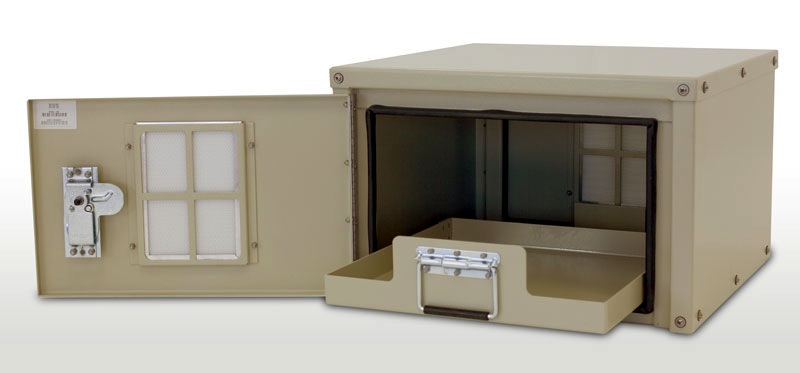
OK Premium Enclosures Hinged Cover Battery Enclosures series hinged cover enclosures are engineered specifically for the OEM industry allowing the installer to add controllers and other electrical and electronics components.

Additional back, side and door panels are available. Designed for outdoor use, NEMA type 3R/12 construction, enclosures have bottom-to-top rain and dust proof vent design. A removable front opening door is lined with a sealing gasket and includes a special keyed cam-lock and dust cover. These enclosures are white powder coated aluminum for ultimate protection in severe climates.
For applications in extreme hot or cold conditions, space is available for additional 1” foam insulation around the battery.

Features:

  • 3 mOkels for either 1, 2 or 4 batteries (125 Ah)

  • Vertical design on 4 battery enclosure (2 + 2) with removable interior shelf

  • Passive venting with dust filtration pads

  • 1/4 turn cam-locking door latches with special key and dust cover

  • Electrical knockouts and ground lug hole on rear

  • Rear-top of enclosure ‘hanger’ built in for easy

  • installation onto mounting brackets

  • Vandal resistant mounting brackets and U-bolt sets are sold separately


Traffic Enclosures
Item # Description
777145NEMA Metal Traffic Enclosures Outside Dimesions
39"H x 26 3/4 "D x 25"W

Inside Dimensions
35"H x 26 1/4"D x 24"W

2 Sets of 19" Racking w/
Removable Rail Cage
777147
NEMA Metal Traffic Enclosures
Outside Dimesions
49"H x 26 3/4 "D x 25"W

Inside Dimensions
45"H x 26 1/4"D x 24"W

2 Sets of 19" Racking w/
Removable Rail Cage
777261
777262
777263
Rectifier Enclosures with 19" rack mounts.
More Information


flasher cabinets have weather resistant door seals and are available for top and bottom or rear mounting. Cabinets can be fully wired with time clock, NEMA or 5-pin strip, circuit breaker and on-off toggle switch. They are supplied with either standard Type II or Police style locks and keys. Traffic flasher cabinets have weather resistant door seals and are available for top and bottom or rear mounting. Cabinets can be fully wired with time clock, NEMA or 5-pin strip, circuit breaker and on-off toggle switch. They are supplied with either standard Type II or Police style locks and keys.
777271
Fiber Outdoor Cabinet 62 inches H X 42 inches D X 51 inches W


Battery Box Enclosures
 

Item # Description
777155
Outdoor Battery Box
16" High,25"Deep,25" Wide, Mounting Tray 2" H X 17"D X 17"W
Painted Cream
777156
Outdoor Battery Box 16" High,34"Deep,25" Wide, (Mounting Tray 2" H X 26"D X 17"W) Painted Cream
777157
Outdoor Battery Box 16" High,42"Deep,25" Wide, (Mounting Tray 2" H X 34"D X 17"W) Painted Cream
777020
 21-22 Aluminum Top-opening battery enclosure - Top opening battery
enclosure
Designed to House Large batteries some examples are = Quantity 8 Battery Group 4D or Quantity 6 Battery Group 8D.
777251
Chest-style Battery Enclosures for maximum security and protection.
777252
Chest-style Battery Enclosures for maximum security and protection.
777253
Chest-style Battery Enclosures for maximum security and protection.
777025
Polyethylene Battery Enclosure


Climate Control Options
Racking and Non Racking Cabinet Enclosures

Air Conditioners
closed-loop enclosure cooling systems to compliment today's highly engineered work stations.
35% more energy efficient
40% more savings in space
45% lighter in weight

AIR CONDITIONERS

Top and Side Mount Enclosure Air Conditioners. High Ambient, 120V, 230V and 460V models.


TOP MOUNT LINE

Standard
Slim
High Ambient
Hazardous Duty

SIDE MOUNT LINE

Standard
Slim
Extra Slim
High Ambient
Hazardous Duty
Hazardous Duty Slim
Hazardous Duty Extra Slim

IQ MANUFACTURES A COMPLETE LINE OF TOP AND SIDE MOUNT ENCLOSURE AIR CONDITIONERS WITH THE FOLLOWING FEATURES:
Digital temperature controller with alarm
Durable 16 gauge welded steel construction or stainless steel
Built in condensate evaporation package
Easy pull-out filter
Efficient, quiet and long lasting rotary compressor
CFC-FREE refrigeration system
Space saving aesthetic cabienet design
100% factory tested
Designed to mount on top or side of enclosure while maintaining nema type 12, 4 , or 4x integrity
Easy to use, programmable temperature controller with alarm
Efficient, quiet and long lasting rotary compressor
Designed to mount on side of enclosure while maintaining NEMA type 4 or 12 integrity

Optionals:
Ethernet controller also available.
Manufactured for hazardous locations and not merely air conditioners that were converted by a third party.
Item # Description
AC-1000I 13.12"H x 14.5"W x 8"D
AC-1000I2 13.12"H x 14.5"W x 8"D
AC-1800TM 7.25"H x 10"W x 24.25"D
AC-2000I 22.25"H x 11.5"W x 6.25"D
AC-2000I2 22.25"H x 11.5"W x 6.25"D
AC-4000I-H 30.10"H X 12.27"W X 8.34"D
AC-4000I2-H 30.10"H X 12.27"W X 8.34"D
AC-60001 35.97"H X 15.94"W X 7.35"D
AC-600012 35.97"H X 15.94"W X 7.35"D
AC-80001 42.10"H x 15.94"W x 10.35"D
AC-800012 42.10"H x 15.94"W x 10.35"D
AC-1000012 52.09"H X 17.65"W X 10.34"D
AC-1200012 52.09"H X 17.65"W X 10.34"D
 

Heater Options

Item # Description
777169 100 Watt 115V AC Flex
777170 300 Watt 115V AC Flex
777168 600 Watt 115V AC Flex
777171 600 Watt 48V DC Flex
400 Watt Fan Heater


AC & DC Fan Kits


Item # Description
OkDFMP-168 16" X 8" Fan & Inlet Panel Plate Kit
OkOkF-25-115T 2 - 115 Volt 220 CRM Fan Kit with Thermostat
OkF-25-115 2 - 115 Volt 220 CFM Fan Kit without Thermostat
OkF-25-220T 2 - 220 Volt 220 CFM Fan Kit with Thermostat
OkF-25-220 2 - 220 Volt 220 CFM Fan Kit without Thermostat
OkF-25-48T 2 - 48 Volt 220 CFM Fan Kit with Thermostat
OkF-25-48 2 - 48 Volt 220 CFM Fan Kit without Thermostat
OkF-25-24T 2 - 24 Volt 220 CFM Fan Kit with Thermostat
OkF-25-24 2 - 24 Volt 220 CFM Fan Kit without Thermostat
OkF-25-12T 2 - 12 Volt 220 CFM Fan Kit with Thermostat
OkF-25-12 2 - 12 Volt 220 CFM Fan Kit without Thermostat
OkF-15-115T 1 - 115 Volt 220 CFM Fan Kit with Thermostat
OkF-15-115 1 - 115 Volt 220 CFM Fan Kit without Thermostat
OkF-15-220T 1 - 220 Volt 220 CFM Fan Kit with Thermostat
OkF-15-220 1 - 220 Volt 220 CFM Fan Kit without Thermostat
OkF-15-48T 1 - 48 Volt 220 CFM Fan Kit with Thermostat
OkF-15-48 1 - 48 Volt 220 CFM Fan Kit without Thermostat
OkF-15-24T 1 - 24 Volt 220 CFM Fan Kit with Thermostat
OkF-15-24 1 - 24 Volt 220 CFM Fan Kit without Thermostat
OkF-15-12T 1 - 12 Volt 220 CFM Fan Kit with Thermostat
OkF-15-12 1 - 12 Volt 220 CFM Fan Kit without Thermostat


Accessory Options Racking and Non Racking Cabinet Enclosures Pole or Wall Mounting Shelf
 
Item # Description
7774013
POLE OR WALL MOUNTING SHELF 14"H X 30"W X 30"D

Mounting Shelves Extra Rails, Lifting Hooks, Feet, Casters
Item # Description
MT-D 12" Deep Mounting Tray
MT-DX 20" Deep Mounting Tray
MT-DD 29" Deep Mounting Tray
MT-DDX 37" Deep Mounting Tray
SMT-17 17" Deep Adjustable Single Rail Mounting Tray

Extra Rails, Lifting Hooks, Feet, Casters
Item # Description
PR-2-10 Xtra POk-Series 10" Rails, 19" Racking
PR-2-30 Xtra POk-Series 30" Rails, 19" Racking
R-2-30 Xtra Ok-Series 30" Rails, 19" Racking
R-2-50 Xtra Ok-Series 50 " Rails, 19" Racking
R-2-62 Xtra Ok-Series 62 " Rails, 19" Racking
R-2-78 Xtra Ok-Series 78" Rails, 19" Racking
R-2-30-23 Xtra Ok-Series 30" Rails, 23" Racking
R-2-50-23 Xtra Ok-Series 50" Rails, 23" Racking
R-2-62-23 Xtra Ok-Series 62 " Rails, 23" Racking
R-2-78-23 Xtra Ok-Series 78" Rails, 23" Racking
STR-2-30 Xtra ST-Series 30" Rails
STR-2-42 Xtra ST-Series 42" Rails
I Hooks Lifting Eye-Hooks Kit Qty-4
CF-4 Two 4" C-Chan. Feet 25" Long w/ Mtg Hardware
CA-4 Set of Heavy Duty Caster Kit (4)
.5MICRONS Two 5 Micron Nylon Replacement Filters 7 1/4"W X 10"H
.5INS 1/2" R3.3 Polystyrene Insulation Installed Completely Inside Enclosure
CB3-DX 3"H - 4 Sided Pedestal Base for DX- Enclosure
CB3-DD 3"H - 4 Sided Pedestal Base for DD- Enclosure
CB3-DDX 3"H - 4 Sided Pedestal Base for DDX- Enclosure
VIB-25 Set of Shock Mounted Vibra-Bobbins for 19" or 23" Racking Rails
COL-4 4" COLLAR TO JOIN 2 ENCLOSURES TOGETHER FOR CABLE PASS THRU
Heavy-duty Battery Racks for service, storage, and transport. More Information

Power System

Battery Backup Systems for LED Traffic Signs Increase the public safety and reduced traffic congestion by allowing traffic lights to function even during a power failure. A typical traffic signal intersection experiences eight to ten local power outages annually. With IQUPS battery backup power, some or all the traffic control signals can continue to operate. This seamless switchover to battery power increases public safety and eliminates the need to dispatch police or other service personnel to direct traffic. If all traffic signals were converted to LEDs, the battery backup system would allow full operation of the traffic signals during a power outage, thus alleviating traffic congestion.

Important feature is the battery backup system’s ability to maintain the memory of the traffic signal controller. The controller is responsible for sequencing the on and off times of the various signals. With a battery backup system, the controller’s memory can be maintained and return to normal operation once the outage has ended. This feature has eliminated the time spent to reprogram controllers after a power outage

Traffic IQUPS It is designed to provide backup power for critical LED traffic light intersections. With 1,000 watts of true sinewave power available, IQFuel Cell and maintenance free Deep cycle batteries.

Traffic IQUPS will drive most large LED systems. Its pure sinewave output is cleaner than utility power, making it ideal for all loads.

Total distortion is typically less than 1.5%. Manufactured in the USA to the highest standards possible, Traffic IQUPS system is the best choice for critical load protection. power outage knocked out traffic lights, backup generators, emergency generator

Depending on the consumers needs, the IQFuelCell automatically charges the battery with up to 100 Ah per day. As independent power supply or in combination with other systems, the IQFuelCell runs self-sufficiently for months.

The circuit is fully protected via breakers and fuses on the AC input, connection to the batteries, and DC loads. Outdoor, lockable, aluminum enclosure includes tamper-proof hardware suitable for pole or wall mounting. DC ripple <50mV.